We have been keeping chickens on our suburban block since Feb 2009, which is not all that long, but long enough to have a few tales to tell. In that time we have had 7 animals, and sadly only 3 are still alive today. This is the story so far.
It started with me building a cage for them under our deck, which gives a huge secure run of over 10 meters. One end of it is always dry, and this is where I put their laying station and coop. Initially there was one door in, but a little later I put another door at the other end, which allowed them to easily free-range in the small back garden we have.
We started with 2 "Light Sussex" birds, both around a year old. We called them Henny and Becky. The light part of the breed name is due to them being mostly white, as for weight, they are solid birds. Henny is on the right, for what it's worth (click for larger image).
Becky was the leader, and was tough but very fair - caring even. She spoke with a soft cooing, and was very easy to like. I say spoke because in my experience, all chicken communicate - but have their own unique sounds. Henny, at the time, was very timid, and kept her distance where possible.
Things were going well, so we decided to increase the flock to 4, by adding two more light sussex birds. We found some going reasonably cheap, and I drove to a parking lot in the middle of nowhere to pick them up. We called these two Max and Shelly.
Unfortunately, this is where some trouble started. The two new birds were younger, at about 12 weeks, and almost as soon as we got them home they got sick with "Bird Pox", which is not a big deal for an older bird but very rough on the younger two. We were also still very green at chicken maintenance, and this was also quite rough on us. It also happened to coincide with a long rainy period, where it was miserable for everyone. The two younger birds got progressively worse over the course of a week or so, and despite reassurance from the internet research that it would all be good, it wasn't. We were hand feeding the birds, giving them medicine and it all wasn't working. Their heads were swollen with sores, and their eyes covered over. They could not see to eat.
Shelly died. Max was renamed Plucky, as she really tried hard to live on, and showed a real sense of spirit. Going through the ordeal together we were willing her on, and formed quite a bond with this little being. She did, in fact, survive the Pox but a few weeks later we noticed a slight cloud in one eye. This appeared in the other eye, and we suspected she was slowly going blind. While she could still see to eat, she continued to grow and although identification is difficult, I believe we even got one or two eggs from her. One day though, about 6 months later, it was clear she could not see enough to eat, and was starting to waste away. She is the only bird I have had put down, it was the only humane thing to do. I can't kill a chook myself (not a pet anyway) so I took her to a vet. Really, we should have eaten her, but I doubt any of us would have eaten a bite if she was dinner.
One morning, unexpectedly, Becky was found dead in the Coop, near the door. A close examination of her showed no signs of problems - in fact, apart from being stone dead she was in perfect health! At around this time there was an unwanted visitor into the chook house - a possum. It was eating the chicken food. It took me a long time to work out exactly how it was getting in to the pen, as I had made the wire go all the way to the roof. I believe what happened is that the possum, in the morning, decided to take refuge in the coop and trapped poor Becky, who simply died of shock. It was a sad day, and there was wailing from the kids for some time.
From then on, Henny was the leader and we saw another side to her. She started out being quite vicious, but has since mellowed quite a bit. She still doesn't take any crap from anyone, and will peck someone out of the way if they don't get the message early. She's stopped being frightened of me, in fact, quite likes being around me.
The flock was getting a bit lean again, and as chooks are social animals you don't want to risk having just one. So I decided to go and get some more birds. We researched breeds and decided to get a different kind this time - the Australian bird the Australorp. They are all black birds with a beetle green sheen to them - very striking. But a funny thing happened when I was at the chook farm. I wanted to get three chickens. They also had white leghorn crosses, and Rhode Island Reds. I decided to come home with one of each breed, much to the exasperation of my better half. These new birds were named Lily (white leghorn), Mabel (Australop) and Artemis (from a book, Artemis Fowl - the Rhode Island Red). I did insist that all three get a jab for Bird Pox, which was not a standard procedure.
These young chooks were the three amigos, and I separated the henhouse so that they could see the other chooks though the barrier and get used to each other. Then I made a small hole so the small birds could go in with the bigger ones, and come back to safety if they wished. After a scuffle or two, this worked, and before long these birds were a flock. It took about a fortnight.
One issue we have with the location of the hen run is that it does get hot down there. Despite being in the shade, 40+ degree days are really nasty. To add to this, the air conditioning compressor is located near their run, and when it's very hot we want to put this on, which blows HOT air around outside. The solution is to have an A-frame cage in the garage, and on days that are going to get really hot we moved the birds into the cool area and they just had to chill out there. It was on one such day that the Rhode Island Red, Artemis, suffered more than the others and passed away. We think that in the tighter constraints of the A-frame she might have not been able to get to the water easily. She was a quirky chook, and again, sorely missed.
Since that time, and touch wood, we have had a lot more success, and have developed a routine that seems to work for everyone. Each morning a bowl of food is prepared for the birds (usually a slice of bread, some lettuce chopped up, and perhaps some leftovers, mixed with a little sunflower seeds and scratch mix). They always have dry food, softened dry food (ie wet in a bowl) and three sources of fresh water, including a huge water bell. The girls have been laying eggs for us most days, and we have not had to buy too many in the last year or so. Mabel took the longest to produce eggs, and hers have a slight mauve tint to them. She's a really sweet hen, so soft and gentle. Lily is a dumb blonde, and I don't think I would get another leghorn - except for the fact that she is by far the most reliable layer in the flock. The only thing I don't like about the Light Sussex is that sometimes they get "dirty" bum feathers, which need some trimming to keep clean.
Mabel recently went broody - she just wanted to stubbornly sit on her nest and do nothing else. This caused some issues, firstly that the laying station was occupied and the other hens had to find somewhere else to lay their eggs. She goes into a trance, and will even sit on an empty nest. I have to pick her up and put her down in front of food for her to snap out of it, for a while, so that she eats and drinks before clucking her way back onto the nest. I tried to separate her, but really, she got quite distressed and I didn't like to see her like that. We have not had any eggs from her for a while, and she's lost a lot of weight, but I'm hoping she'll snap out of it soon. They say it's a compliment to your chicken keeping abilities if a bird is happy enough to go into this state, and I hope this is true.
One thing that I have learnt is that each bird has it's own personality and character. They all like a routine, but perversely, they will change at least one thing per day! That may be the sleeping arrangements, the place they lay eggs, the number of eggs, what they eat, something. It's become somewhat of a joke that I come back from visiting the hens and say as I walk in the door "well, that was different!". "What now!?", everyone yells. This makes owning chickens fun, in my opinion, you never quite know what's going to happen next. It's work too, there is no doubt about that, and it's also somewhat costly, but it's worth it. They make good pets, are friendly, and entertain. When I go down of a morning with their food and Henny runs to the door to greet me, it cracks me up every time. The eggs are very special, not just because they are as fresh as is possible, and organic, and delicious, but because you have had a major part in caring for the creature that provided it. It's proof that it's all working, and it's good for them and it's good for you - you can taste it!
Sunday, November 28, 2010
Thursday, November 25, 2010
Mad Skillz - Part 2
It's been a while since I wrote Part 1, where I discussed spinning and knitting. Since then, or perhaps in parallel, I have obtained a bunch of other skills. Nothing here on it's own is much to talk about, but in total I think you will see that it's got a direction and purpose.
Chickens - This deserves a post all on it's own, and I think I will do this one day - the story of the chickens, but not here and now. Rearing chickens is a skill, of that there is no doubt, and in some ways a chore. You need to understand them at least a little, to make them happy, safe and secure. There is daily feeding and watering. The chicken mind is quite something, and they all have very distinct personalities. When they are happy and healthy, the eggs are extreme in their deliciousness. Any cakes or dishes made with them are fantastic. I really like chilling out with my chooks. We have 3 chooks at present -- Henny (an original), Mabel and Lily. "Three egg" days are the best days you can have.
Rat Catcher - Whatever chickens like to eat, rats like to eat too. So if you keep chickens, at some point, you will also be dealing with rats (and if you leave that too long, in Australia, snakes!). So, I have also been trapping rats, killing and burying them - about 30 or so to date. The traps I use are cages, which capture them live. I then drop them into a bucket of water, and they are dead in a minute or so, doesn't take long. When I first did this, my heart was racing, and now it doesn't skip a beat. I guess I've learnt how to kill, and you could argue that this is not a good thing. One good side effect of this rat disposal is that we no longer have the pitter patter of tiny feet in our roof, which was disturbing our sleep and leaving droppings everywhere. I check each animal I catch to make sure it's not a native marsupial, if I ever get one of those I'll let it free. We have also caught a few "rats with wings", the annoying birds (not sure of the breed) that come and steal the seed too. I let them go - but perhaps I shouldn't.
Bees - Similar to keeping chickens, but not really the same, are Bees. I like Bees a lot, and we inherited a bee hive from our next door neighbour when he moved. We have had the hive about a year now, but I have not opened it since moving it. Before they left we had a harvest and got 30 jars of the most delicious honey I have ever had. I managed to score 6 jars, which was a lot really. When I have some time, and it's not too hot or windy, I'll suit up and take a peek. I hope the hive is healthy, as there was some evidence of hive beetle present. Fingers crossed.
Knives - Well, if you read my other posts you'll see I have quite an interest there. I won't go into details now, other than to say my collection now spans about 40 folding knives. I think I'm near the end of my accumulation though!
Knife Sharpening - When you own a knife, one metric on how good it is, is how sharp it is. When you get a knife that you really like and it's blunt as a butter knife, then the issue of sharpening is raised. My early sharpening efforts were pretty poor. I got a diamond stone off eBay with 4 grit strengths. The problem is that it tended to chip the edge in my hands, and produce otherwise uneven results. The standard kitchen sharpener is made to fix a rolled edge, not really sharpen. And the hand held ones with the disks inside seemed too dinky for me, like sharpening for dummies. After some time brewing on this issue I bit the bullet and purchased a Lansky sharpening kit, which has the ability to control the angle that the sharpening is happening. It takes some time, but I am a lot more confident of the results.
Knife Making - Again, there is a recent post that goes into this in a lot more detail, so I won't go over it all again, but making knives is a skill. It's one I enjoyed learning, but do not see that I will be putting into practice a great deal. It takes a lot of equipment, for a start, and time.
Knife Accessories - So once you have made your knife you need to store it, and the question of a sheath comes up. I scored some free leather scraps, and managed to make two sheaths for my made knives. They are really just blade covers, using paracord in the stitching, but they came out alright. I added a plastic lining on the inside so that the leather would not get cut. The results are quite amateur, but the whole point was to learn about the art, not to produce a masterpiece. Using the parachord I have also made lanyards, and a Cobra bracelet. Youtube is an amazing resource for learning quick little skills like this, and there is no shortage of people online who are great at teaching you if you want to learn.
Vegi Patch - Gardening is no big deal, but on our land it has some challenges. One thing I have done is compost the chicken litter and poo, and this makes for some great organic fertiliser. In truth, the vegi patch is a bit of a failure, mostly for it's location, but the current plot has some beans, lettuce, pumpkin and parsley. Elsewhere in the garden we have a lemon, mandarin and rosemary bush. It's not much, but it's better than nothing and I take a huge amount of pride and joy in eating anything that our land manages to bear. It always tastes great, even if it's only a mouthful or so!
So, I think that's everything! I'm not sure what's next in the long search for happiness, but I'm pleased with the things I have done so far.
Tuesday, October 26, 2010
Knives - The Next Generation
Well it was kind of bound to happen. As I seem to be on a journey to learn basic life skills, and have also developed a hobby of collecting and appreciating knives, so it is somewhat natural that these two things have collided. The result of this collision was a weekend knife making course in Canberra at the Tharwa Valley Forge. It was quite expensive, and was a birthday present to myself.
To cut to the chase, I made these two knives ...
Which I have to say I'm quite proud of, for my first attempt! These knives took two days of fairly hard work to make. The first part, where the blade was forged out of a steel bar was particularly hard for me, and I lost arm strength when in the last stages of the bowie (lower one). The hammers become super heavy after swinging them around for an hour or so.
The top knife was based on a book I read during the weekend on Bob Loveless, a classic american knifemaker. I really like his knife designs, for their simplicity has great functional beauty. The book also told his life story, and it was interesting in itself, but now ended as he has recently died. So my homage to him was the deliberately finer of the two knives, with a "less is more" approach trying to copy as many of his design elements as I could. The spine of the blade was supposed to be level with the guard, and it's close, but not quite right. I have since sanded it down a fraction more.
Both knives are pretty close to the design I did in on the first night, actually, as this shot shows. Note that I did the design in pen, which is fairly stupid. The bowie was not supposed to have such a large ricasso, but there are so many times that I just had to say "Well, it's not perfect but in the time I have, and the skills I have, it's the way it is, so move on!".
The steel has been properly heat treated, and due to it's thickness I believe will last a long, long time with proper care. The wood used on the Loveless is Jarra (dark) and Applebox (lighter), on the bowie is Mulga. The mulga is heavier, harder, has a nice glow to the wood and has nice grain. The black part of the bowie is in fact a plastic material used in kitchen benchtops, and has a slight fleck to it. The yellow metal is brass, which over time will tarnish if it's not polished of course.
I really enjoyed making these knives. The course was well run, friendly, and informative. The sense of achievement at the end was uplifting. It was also exhausting, and sleeping was no problem after each day!
What's next then? Well, I could make some more blades, but I do not have a burning desire to do that at the moment. I think I could do a better job of creating the knives a second time around, BUT on the other hand I don't have all the equipment nor a friendly and skilled teacher to save me from major mistakes (like not making the blade straight, for example...). I have developed a deep respect for well finished hand made knives. I now know, first hand, how hard it is. Mass produced knives have made us expect perfection, and in a hand made world, this is a very tall order.
Instead then, I am motivated by an outstanding need -- what I need to do is make some leather sheaths to hold the knives. They need a home, and a way for me to carry them should I want to. This is another skill to learn, one I want to learn as much for the sake of completeness than anything else. I do like the creative element of leather work, so perhaps I will really groove to it once I try it, I don't know yet.
I am also not quite happy with the sharpness levels on these knives. The bowie is the best of the two, and I de-boned a leg of lamb a few days ago and it did the job better than any other knife we have in the kitchen. I already have some sharpening tools, but I'm not really happy with them or the results I have gotten so far. Again, I am learning a skill here, but I think I might not have the right tools for the job yet. So... I have invested in another eBay purchase, this time a Lansky sharpening system, which should keep the angles sorted and hopefully enable me to get a really fine edge. My goal is to make them shaving sharp.
If I create a really nice sheath, and get them good and sharp, there is one last step to make them completely "done". That is, getting them engraved with my mark. I have already scoped that out with an engraver (I won't do it myself) and there is a moderate cost involved, so I may or may not go that extra step.
The journey continues!
To cut to the chase, I made these two knives ...
Which I have to say I'm quite proud of, for my first attempt! These knives took two days of fairly hard work to make. The first part, where the blade was forged out of a steel bar was particularly hard for me, and I lost arm strength when in the last stages of the bowie (lower one). The hammers become super heavy after swinging them around for an hour or so.
The top knife was based on a book I read during the weekend on Bob Loveless, a classic american knifemaker. I really like his knife designs, for their simplicity has great functional beauty. The book also told his life story, and it was interesting in itself, but now ended as he has recently died. So my homage to him was the deliberately finer of the two knives, with a "less is more" approach trying to copy as many of his design elements as I could. The spine of the blade was supposed to be level with the guard, and it's close, but not quite right. I have since sanded it down a fraction more.
Both knives are pretty close to the design I did in on the first night, actually, as this shot shows. Note that I did the design in pen, which is fairly stupid. The bowie was not supposed to have such a large ricasso, but there are so many times that I just had to say "Well, it's not perfect but in the time I have, and the skills I have, it's the way it is, so move on!".
The steel has been properly heat treated, and due to it's thickness I believe will last a long, long time with proper care. The wood used on the Loveless is Jarra (dark) and Applebox (lighter), on the bowie is Mulga. The mulga is heavier, harder, has a nice glow to the wood and has nice grain. The black part of the bowie is in fact a plastic material used in kitchen benchtops, and has a slight fleck to it. The yellow metal is brass, which over time will tarnish if it's not polished of course.
I really enjoyed making these knives. The course was well run, friendly, and informative. The sense of achievement at the end was uplifting. It was also exhausting, and sleeping was no problem after each day!
What's next then? Well, I could make some more blades, but I do not have a burning desire to do that at the moment. I think I could do a better job of creating the knives a second time around, BUT on the other hand I don't have all the equipment nor a friendly and skilled teacher to save me from major mistakes (like not making the blade straight, for example...). I have developed a deep respect for well finished hand made knives. I now know, first hand, how hard it is. Mass produced knives have made us expect perfection, and in a hand made world, this is a very tall order.
Instead then, I am motivated by an outstanding need -- what I need to do is make some leather sheaths to hold the knives. They need a home, and a way for me to carry them should I want to. This is another skill to learn, one I want to learn as much for the sake of completeness than anything else. I do like the creative element of leather work, so perhaps I will really groove to it once I try it, I don't know yet.
I am also not quite happy with the sharpness levels on these knives. The bowie is the best of the two, and I de-boned a leg of lamb a few days ago and it did the job better than any other knife we have in the kitchen. I already have some sharpening tools, but I'm not really happy with them or the results I have gotten so far. Again, I am learning a skill here, but I think I might not have the right tools for the job yet. So... I have invested in another eBay purchase, this time a Lansky sharpening system, which should keep the angles sorted and hopefully enable me to get a really fine edge. My goal is to make them shaving sharp.
If I create a really nice sheath, and get them good and sharp, there is one last step to make them completely "done". That is, getting them engraved with my mark. I have already scoped that out with an engraver (I won't do it myself) and there is a moderate cost involved, so I may or may not go that extra step.
The journey continues!
Saturday, October 23, 2010
Knife review : BEE L05-1
I now have a collection, which I started only about a year ago, of about 30 or so folding knives. This collection is partly discussed in my posts
Knives - Part 1
Knives - Part 2
Leatherman Squirt P4 vs S4 vs PS4
My collection has brands such as Buck, Kershaw, Benchmade, Spyderco, CRKT and others. Today I want to brain-dump a bit on a different knife however. This one.
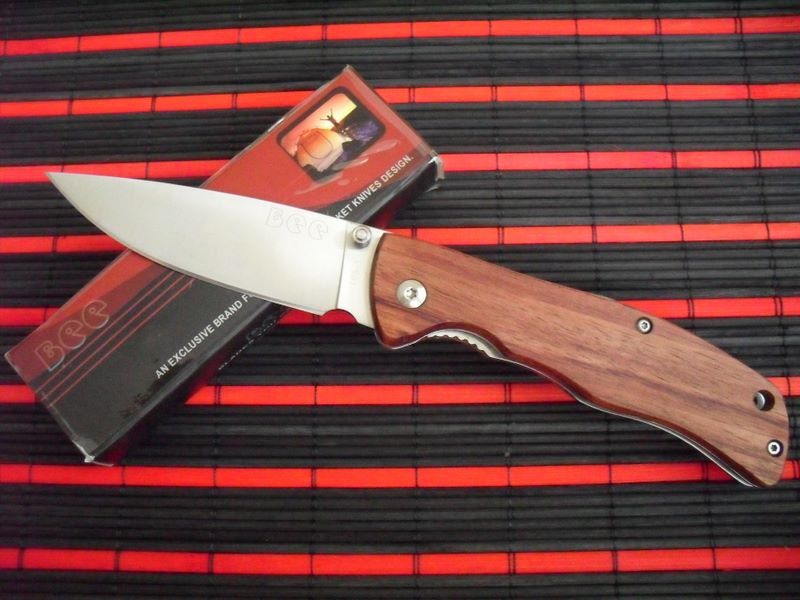
As this post title suggests, it's the BEE L05-1 model, which is etched on the base of the blade. It's a fairly large knife, filling my hand with the handle when open. The blade is full flat ground, almost 9cm long, with a liner lock and wood scales. A nice touch is that the top back of the blade has been rounded off, so that it does not jut out when the knife is closed.
I really love this knife, it's by far my current favourite. The main reason that I want to pick up this knife all the time is it's opening action. The ergonomics for my hand are just perfect - my thumb falls into the right place below the stud, and a gentle flick of it and the blade comes out. Now that I have used this blade for a while I realise that the others I have used are cramped in this area.
I should mention that this smooth action is not quite the way it came to me. It was a little stiff in it's action, and felt like there might have been some sand or grit in the mechanism. What was worse was that the liner did not engage the way I wanted it to - it only just caught the back of the blade, and sometimes not much at all. This represented a safety issue, and I wanted a reliable lockup each and every time.
So I took the knife apart (which is fairly easy, having torx screws holding it together). Once I had the blade out I used my bench grinder to take off a fraction at the back of the blade, being careful to keep the slight angle it already had. I was somewhat cautious about doing this, as too much off would make the lock travel all the way across the blade and introduce blade play. So keep in mind when doing this -- too much is a disaster. I briefly sanded the blade on 240 grit paper. Then I re-assembled the knife, adding in some globs of grease to the bushings. There is one bronze, one plastic (teflon?) - worth noting which way these go before you take it all apart.
I was very happy with the result of my tinkering. I managed to take of exactly the right amount off the back of the blade so that the liner is fully, but just, engaged every time. This was probably good luck more than skill, but I'll take it! There is plenty of wear left on this knife. Also, the lubrication had the benefit of making the opening action super smooth. I was able to adjust the tightness of the pivot screw so that it was easy to open, and the blade was still almost centred. This is why it's such a joy to open - it's easy to flick open, and locks up tight when it does.
An important part of a liner lock knife is not just the lock up, but also what it's like to unlock the knife and put the blade away. This is also really nice on this knife. The liner is fairly easily pushed away, and the blade can be pushed back one handed. Now here is an important thing : the choil (the semi-circular cut out at the base of the cutting edge, near the pivot) is generous and means that you are not in any risk of cutting your finger as you close the blade. The choil hits your thumbnail if you don't get it out of the way fast enough. Also, when opening, if you fumble and it weakly opens and doesn't lock, you can push on this choil area to engage the lock.
The other positive about this knife are that it feels nice all over (good shape, good materials), and it looks good. The knife steel is the standard Chinese of 8Cr13Mov, which is good enough. It's not great, but it's ok. One thing that I find amazing is that this knife cost me around $20! This is an absolute bargain.
Are there any complaints about this knife? Sure, well, firstly I should not have had to take it apart to get the lockup to be perfect. Mind you, this may just be my sample. It has no gimping on the spine of the knife, and the lanyard hole is not lined. It's quite heavy. The BEE logo looks like something right out of the 70's, which I find cute but you might not like. The screws which hold the belt clip on seem to have come loose a bit, I have re-tightened them, so I'm watching that issue.
Overall though, this is a knife I really, really like. So much so that I bought another one - so that I have one for work and one at home. I have also bought (but not yet received) the BEE L05 (not L05-1) which has the black G10 scales rather than the wood. It promises to be a great knife also. Do a search for this model on eBay and pick one up on the cheap, they are well worth it in my opinion. I have knives that cost me 10x as much as the BEE L05-1, but I use them 1/10th as often!
Update 2010-12-29 : I have now used several L05-1 and L05's, and they are great, great knives for the price or even triple the price. The lockup issue above was not repeated on any other I've handled (~8 now), although most came stiff and benefited from a take apart and light application of grease around the bushings. It's good to have two torx screwdrivers for this -- one for each side of the knife, or else sometimes one side just spins. I have given this knife away for Christmas presents, and they have gone down well. I have one of these by my computer at work and home, and by my bed. They also fit nicely in jeans pockets and carry well. I say : Get one!!!
Knives - Part 1
Knives - Part 2
Leatherman Squirt P4 vs S4 vs PS4
My collection has brands such as Buck, Kershaw, Benchmade, Spyderco, CRKT and others. Today I want to brain-dump a bit on a different knife however. This one.
As this post title suggests, it's the BEE L05-1 model, which is etched on the base of the blade. It's a fairly large knife, filling my hand with the handle when open. The blade is full flat ground, almost 9cm long, with a liner lock and wood scales. A nice touch is that the top back of the blade has been rounded off, so that it does not jut out when the knife is closed.
I really love this knife, it's by far my current favourite. The main reason that I want to pick up this knife all the time is it's opening action. The ergonomics for my hand are just perfect - my thumb falls into the right place below the stud, and a gentle flick of it and the blade comes out. Now that I have used this blade for a while I realise that the others I have used are cramped in this area.
I should mention that this smooth action is not quite the way it came to me. It was a little stiff in it's action, and felt like there might have been some sand or grit in the mechanism. What was worse was that the liner did not engage the way I wanted it to - it only just caught the back of the blade, and sometimes not much at all. This represented a safety issue, and I wanted a reliable lockup each and every time.
So I took the knife apart (which is fairly easy, having torx screws holding it together). Once I had the blade out I used my bench grinder to take off a fraction at the back of the blade, being careful to keep the slight angle it already had. I was somewhat cautious about doing this, as too much off would make the lock travel all the way across the blade and introduce blade play. So keep in mind when doing this -- too much is a disaster. I briefly sanded the blade on 240 grit paper. Then I re-assembled the knife, adding in some globs of grease to the bushings. There is one bronze, one plastic (teflon?) - worth noting which way these go before you take it all apart.
I was very happy with the result of my tinkering. I managed to take of exactly the right amount off the back of the blade so that the liner is fully, but just, engaged every time. This was probably good luck more than skill, but I'll take it! There is plenty of wear left on this knife. Also, the lubrication had the benefit of making the opening action super smooth. I was able to adjust the tightness of the pivot screw so that it was easy to open, and the blade was still almost centred. This is why it's such a joy to open - it's easy to flick open, and locks up tight when it does.
An important part of a liner lock knife is not just the lock up, but also what it's like to unlock the knife and put the blade away. This is also really nice on this knife. The liner is fairly easily pushed away, and the blade can be pushed back one handed. Now here is an important thing : the choil (the semi-circular cut out at the base of the cutting edge, near the pivot) is generous and means that you are not in any risk of cutting your finger as you close the blade. The choil hits your thumbnail if you don't get it out of the way fast enough. Also, when opening, if you fumble and it weakly opens and doesn't lock, you can push on this choil area to engage the lock.
The other positive about this knife are that it feels nice all over (good shape, good materials), and it looks good. The knife steel is the standard Chinese of 8Cr13Mov, which is good enough. It's not great, but it's ok. One thing that I find amazing is that this knife cost me around $20! This is an absolute bargain.
Are there any complaints about this knife? Sure, well, firstly I should not have had to take it apart to get the lockup to be perfect. Mind you, this may just be my sample. It has no gimping on the spine of the knife, and the lanyard hole is not lined. It's quite heavy. The BEE logo looks like something right out of the 70's, which I find cute but you might not like. The screws which hold the belt clip on seem to have come loose a bit, I have re-tightened them, so I'm watching that issue.
Overall though, this is a knife I really, really like. So much so that I bought another one - so that I have one for work and one at home. I have also bought (but not yet received) the BEE L05 (not L05-1) which has the black G10 scales rather than the wood. It promises to be a great knife also. Do a search for this model on eBay and pick one up on the cheap, they are well worth it in my opinion. I have knives that cost me 10x as much as the BEE L05-1, but I use them 1/10th as often!
Update 2010-12-29 : I have now used several L05-1 and L05's, and they are great, great knives for the price or even triple the price. The lockup issue above was not repeated on any other I've handled (~8 now), although most came stiff and benefited from a take apart and light application of grease around the bushings. It's good to have two torx screwdrivers for this -- one for each side of the knife, or else sometimes one side just spins. I have given this knife away for Christmas presents, and they have gone down well. I have one of these by my computer at work and home, and by my bed. They also fit nicely in jeans pockets and carry well. I say : Get one!!!
Sunday, August 29, 2010
Leatherman Squirt P4 vs S4 vs PS4
This post will likely interest only a small number of people on the planet, those who know of Leatherman's tiny multi-tool "Squirt" range, and wonder what they are like, or possibly which one to buy. In particular, the latest model, the PS4 combines some of the features of the previous generation - so it's the latest, but is it the greatest? Note that I am not an electrician, so the E4 is of no interest to me and I don't have one (the main tool is a pair of wire strippers).
Firstly, the three tools share some components. They all have a slip-joint (non-locking) knife, for example. This is decent, and fairly sharp when you first get it, so you need to treat it with respect or you will lose some flesh. Note that it's flat ground but the final edge is only on one side of the blade. I use the blade a lot, it's good to have one in your pocket, and nobody is going to feel life threatened when you pull it out HOWEVER, it's also a good way to lose your tool. All you have to do is take it through airport security and they will confiscate it. In fact, that's where two of mine came from, second hand from airport security auctions.
Moving on, they all also have a bottle opener, wide flathead screwdriver (that's one tool) and a one-dimensional phillips head screwdriver. The later arguably also has a small flat head screwdriver at the end also. The one-D thing, in case you have never used it, works surprisingly well. Anyway, that's it for the common tools amongst the P4, S4 and PS4.
Let's cut to the chase and get to the main tools. The clue is in the name of each tool, of course. S=Scissors, P=Pliers. The only tricky one is the PS4, which has pliers as the main tool... and scissors as a minor tool. I'll go over that again to make it absolutely clear. The S4 has scissors, but no pliers. The P4 has pliers, but no scissors. The PS4 has pliers (main) and scissors (minor). You can't have two main tools, and what I mean by minor is that they are smaller and an outside accessible tool, along with all the others. While I'm on this thought, this is one of the things I really love about the Squirt design - ALL tools are accessible from the outside except the main tool, which requires the wonderful butterfly action to open.
A picture may really help here, so here goes -
So, anyway, scissors versus pliers? They both clearly have their place. The S4 is a fantastic "personal grooming" tool, as is evident by some of the companion minor tools. For more general work though, I feel that the P4 is a better bet. The reason is that the pliers are fine enough to make decent tweezers and can cut string (in the wire cutters). Most other things that you might want to cut with the scissors you can get away with using the blade instead. The scissors in the S4 are pretty decent, however, they are quite short and so you will only get a maximum 25mm cut each time. You don't want to be hacking away at an A3 piece of paper with these little snippers, although they are sharp enough that most times you can run the scissor along once you start a cut (obviously, it depends what you are cutting, but paper or tape would do this).
The scissors in the S4 have some grunt to them then, but in the PS4, not so much. I'd still cut my finger nails with them, but that's about it, and I don't know if it'd get through my toe nail! Maybe. So they are a bit dinky, more like a SAK pair of scissors, and only good for really minor jobs. They are even shorter too, at 16mm by my measure. One good thing -- both are sprung, so a cut comes back ready for the next cut. I like this in the main tools too - the pliers are sprung also, please don't underestimate how good that makes them. The spring action on my PS4 is slightly stronger than the other two.
The reason for so much pontificating about the scissors is that they are the "line in the sand" between the PS4 and the other models. It used to be pliers OR scissors, and now you can have both. Is there a sacrifice? Well, as it turns out there is. Not just the fact, already pointed out above, that the scissors are fairly wimpy. The bigger sacrifice is that the scissors take up two minor tool spots, and one in particular I have found handy in everyday use. The two tools lost (as per the P4) are the jewellers screwdriver and the awl. These are both thin tools, and this is where they become handy, being able to get into cracks or a small hole. The PS4 loses both these tools, and as a consequence, has no thin tool. You could argue that you can use one of the blades of the scissors as a thin tool, but it's not really made for that.
The one tool on the P4 and PS4 that I don't use much (and I wish they had used instead for the scissors) is the file/saw/chisel. I've never used this, actually. Funny, but there it is. I'm sure some people use them "all the time" and think they are wonderful. Not me. The S4 has a more useful tool instead, a metal nail file / cleaning hook / ruler. The ruler is a joke, managing just 3.5cm with some of the markings missing. But the hook/nail file are excellent. Coupled with the main scissors and the metal tweezers, you can see why this is the one to have for "personal grooming".
The PS4 has some other "generational" changes too. The design is somewhat different than the other two. The scales, for a start are a matt finish. I thought they were plastic at first, but discovered they were not. How did I discover this? Well, this leads to another subtle design change : that the scales on the PS4 are considerably less rounded at the edges. Sharp even. And when you are using the pliers they are a bit uncomfortable on the hand. So I went at them with some sand paper, and after some rubbing, I exposed the metal underneath.
The S4 and P4 I have are second hand, and fairly "well loved". One issue with the scales is that the anodised aluminium chips fairly easily, particularly around the end with the keyring. I have not had the PS4 all that long, but I get the impression that the finish on this might last a little better.
What they also did with the PS4 is change the scooping that is in the scales, so that you can access the tools. On the P4/S4, the scoops were generous, and symmetrical, identical on all 4. On the PS4, they are considerably smaller, and not symmetrical. Actually, that's not quite right. The long tools (blade and file) get a long scoop along the length of the tool. The smaller tools get no scoop at all, the thumb nicks being *just* proud of the scales. The scissors get an off centre tiny scoop. It's all a bit random, really, in a modern way. One advantage, I suppose, is that it might be slightly faster getting orientated with the tool when you pull it out of your pocket. With the symmetry on the other models, you get less visual clues. I will say that I've never had a major problem finding the right tool, quickly, on the P4, so this is only a very minor win. I will say that I have found, on occasion, getting tools open on the PS4 a slight fiddle, so that's a bigger loss. I have ok finger nails, but if you bite yours, you might not be able to open the tools at all.
One other thing to mention about the scales on the PS4. They are slightly thicker than the P4/S4, and the whole tool is held together by torx screws rather than thick rivets. The screws are taller than the rivets too, so the overall effect is that the PS4 feels ever so slightly wider (about 1mm, it's not much). Potentially this enables you to take the tool apart. I don't intend to, and I don't think many people will, but I guess that's good. The finish also seems to be less cold to touch on the PS4 too, although I might be imagining it. Might be good if you live in a really cold place, but I don't.
I really know how to crap on about nothing, don't I? But for some strange reason, this stuff is interesting to me. I don't know why!
I think it's important to come to a conclusion here. Which is my favourite? And I'm not going to cop out by say "I like them all", even though, I actually do. Let me eliminate the easy one first then. The S4 stays on my keyboard at home. I don't carry it with me as a rule, and like using it but I could live without it by using other tools more suited for the job (I'm looking at you, nail clippers!).
So that narrows down the field to the P4 and the PS4. I had the P4 as an essential every-day carry for ages, and swapping out to the PS4 has highlighted some of the differences. I am yet to use the dinky scissors, but I have had the PS4 in my pocket and missed the jewellers screwdriver. In terms of the (to me) all important "fiddle factor", the P4 I have has the absolute perfect tension to snap back as I open and close it repeatedly. I even half close it and squeeze just enough for the tool to close on it own. It's a joy to do this, again, I'm not really sure why, it just is. Please note that I have used other P4's, and they do not all have this wonderful tension. If the hinge on the main tool has been damaged, this will be ruined, for example.
So which is it, the P4 or the PS4? C'Mon...
Oh, this is hard. Um. Ok. Well, the PS4 I have is new, and black (which I like). But the P4 is a nice blue too, but it's a bit beat up. Oh. Ah...
It's a close race, really, but in the end my heart is telling me this : the one I like the most, overall is the P4. It's just such a nice, tactile experience to use this little wonder. And it has the tools I most often use. I do prefer the symmetry of the scales, if I'm honest too. I partly wrote this post in an effort to make up my mind about this, so now I'm done. Phew!!
BTW, I would recommend buying any of the Squirts on eBay. The retail stores seem to delight in marking these up the wazoo, so it can be half the price. No matter which one you buy, you will wonder how you ever got on without it. They really are wonderful things (and make great gifts too), I'm a big fan of them. I've never wanted or owned a large multi-tool though, it's a compact size and weight of the squirt that makes it the winner it is.
Edit 2013-07-26 : You may be interested in the review of the Gerber Dime against the Leatherman P4 here!
Firstly, the three tools share some components. They all have a slip-joint (non-locking) knife, for example. This is decent, and fairly sharp when you first get it, so you need to treat it with respect or you will lose some flesh. Note that it's flat ground but the final edge is only on one side of the blade. I use the blade a lot, it's good to have one in your pocket, and nobody is going to feel life threatened when you pull it out HOWEVER, it's also a good way to lose your tool. All you have to do is take it through airport security and they will confiscate it. In fact, that's where two of mine came from, second hand from airport security auctions.
Moving on, they all also have a bottle opener, wide flathead screwdriver (that's one tool) and a one-dimensional phillips head screwdriver. The later arguably also has a small flat head screwdriver at the end also. The one-D thing, in case you have never used it, works surprisingly well. Anyway, that's it for the common tools amongst the P4, S4 and PS4.
Let's cut to the chase and get to the main tools. The clue is in the name of each tool, of course. S=Scissors, P=Pliers. The only tricky one is the PS4, which has pliers as the main tool... and scissors as a minor tool. I'll go over that again to make it absolutely clear. The S4 has scissors, but no pliers. The P4 has pliers, but no scissors. The PS4 has pliers (main) and scissors (minor). You can't have two main tools, and what I mean by minor is that they are smaller and an outside accessible tool, along with all the others. While I'm on this thought, this is one of the things I really love about the Squirt design - ALL tools are accessible from the outside except the main tool, which requires the wonderful butterfly action to open.
A picture may really help here, so here goes -
(Click for larger image)
So, anyway, scissors versus pliers? They both clearly have their place. The S4 is a fantastic "personal grooming" tool, as is evident by some of the companion minor tools. For more general work though, I feel that the P4 is a better bet. The reason is that the pliers are fine enough to make decent tweezers and can cut string (in the wire cutters). Most other things that you might want to cut with the scissors you can get away with using the blade instead. The scissors in the S4 are pretty decent, however, they are quite short and so you will only get a maximum 25mm cut each time. You don't want to be hacking away at an A3 piece of paper with these little snippers, although they are sharp enough that most times you can run the scissor along once you start a cut (obviously, it depends what you are cutting, but paper or tape would do this).
The scissors in the S4 have some grunt to them then, but in the PS4, not so much. I'd still cut my finger nails with them, but that's about it, and I don't know if it'd get through my toe nail! Maybe. So they are a bit dinky, more like a SAK pair of scissors, and only good for really minor jobs. They are even shorter too, at 16mm by my measure. One good thing -- both are sprung, so a cut comes back ready for the next cut. I like this in the main tools too - the pliers are sprung also, please don't underestimate how good that makes them. The spring action on my PS4 is slightly stronger than the other two.
The reason for so much pontificating about the scissors is that they are the "line in the sand" between the PS4 and the other models. It used to be pliers OR scissors, and now you can have both. Is there a sacrifice? Well, as it turns out there is. Not just the fact, already pointed out above, that the scissors are fairly wimpy. The bigger sacrifice is that the scissors take up two minor tool spots, and one in particular I have found handy in everyday use. The two tools lost (as per the P4) are the jewellers screwdriver and the awl. These are both thin tools, and this is where they become handy, being able to get into cracks or a small hole. The PS4 loses both these tools, and as a consequence, has no thin tool. You could argue that you can use one of the blades of the scissors as a thin tool, but it's not really made for that.
The one tool on the P4 and PS4 that I don't use much (and I wish they had used instead for the scissors) is the file/saw/chisel. I've never used this, actually. Funny, but there it is. I'm sure some people use them "all the time" and think they are wonderful. Not me. The S4 has a more useful tool instead, a metal nail file / cleaning hook / ruler. The ruler is a joke, managing just 3.5cm with some of the markings missing. But the hook/nail file are excellent. Coupled with the main scissors and the metal tweezers, you can see why this is the one to have for "personal grooming".
The PS4 has some other "generational" changes too. The design is somewhat different than the other two. The scales, for a start are a matt finish. I thought they were plastic at first, but discovered they were not. How did I discover this? Well, this leads to another subtle design change : that the scales on the PS4 are considerably less rounded at the edges. Sharp even. And when you are using the pliers they are a bit uncomfortable on the hand. So I went at them with some sand paper, and after some rubbing, I exposed the metal underneath.
The S4 and P4 I have are second hand, and fairly "well loved". One issue with the scales is that the anodised aluminium chips fairly easily, particularly around the end with the keyring. I have not had the PS4 all that long, but I get the impression that the finish on this might last a little better.
What they also did with the PS4 is change the scooping that is in the scales, so that you can access the tools. On the P4/S4, the scoops were generous, and symmetrical, identical on all 4. On the PS4, they are considerably smaller, and not symmetrical. Actually, that's not quite right. The long tools (blade and file) get a long scoop along the length of the tool. The smaller tools get no scoop at all, the thumb nicks being *just* proud of the scales. The scissors get an off centre tiny scoop. It's all a bit random, really, in a modern way. One advantage, I suppose, is that it might be slightly faster getting orientated with the tool when you pull it out of your pocket. With the symmetry on the other models, you get less visual clues. I will say that I've never had a major problem finding the right tool, quickly, on the P4, so this is only a very minor win. I will say that I have found, on occasion, getting tools open on the PS4 a slight fiddle, so that's a bigger loss. I have ok finger nails, but if you bite yours, you might not be able to open the tools at all.
One other thing to mention about the scales on the PS4. They are slightly thicker than the P4/S4, and the whole tool is held together by torx screws rather than thick rivets. The screws are taller than the rivets too, so the overall effect is that the PS4 feels ever so slightly wider (about 1mm, it's not much). Potentially this enables you to take the tool apart. I don't intend to, and I don't think many people will, but I guess that's good. The finish also seems to be less cold to touch on the PS4 too, although I might be imagining it. Might be good if you live in a really cold place, but I don't.
I really know how to crap on about nothing, don't I? But for some strange reason, this stuff is interesting to me. I don't know why!
I think it's important to come to a conclusion here. Which is my favourite? And I'm not going to cop out by say "I like them all", even though, I actually do. Let me eliminate the easy one first then. The S4 stays on my keyboard at home. I don't carry it with me as a rule, and like using it but I could live without it by using other tools more suited for the job (I'm looking at you, nail clippers!).
So that narrows down the field to the P4 and the PS4. I had the P4 as an essential every-day carry for ages, and swapping out to the PS4 has highlighted some of the differences. I am yet to use the dinky scissors, but I have had the PS4 in my pocket and missed the jewellers screwdriver. In terms of the (to me) all important "fiddle factor", the P4 I have has the absolute perfect tension to snap back as I open and close it repeatedly. I even half close it and squeeze just enough for the tool to close on it own. It's a joy to do this, again, I'm not really sure why, it just is. Please note that I have used other P4's, and they do not all have this wonderful tension. If the hinge on the main tool has been damaged, this will be ruined, for example.
So which is it, the P4 or the PS4? C'Mon...
Oh, this is hard. Um. Ok. Well, the PS4 I have is new, and black (which I like). But the P4 is a nice blue too, but it's a bit beat up. Oh. Ah...
It's a close race, really, but in the end my heart is telling me this : the one I like the most, overall is the P4. It's just such a nice, tactile experience to use this little wonder. And it has the tools I most often use. I do prefer the symmetry of the scales, if I'm honest too. I partly wrote this post in an effort to make up my mind about this, so now I'm done. Phew!!
BTW, I would recommend buying any of the Squirts on eBay. The retail stores seem to delight in marking these up the wazoo, so it can be half the price. No matter which one you buy, you will wonder how you ever got on without it. They really are wonderful things (and make great gifts too), I'm a big fan of them. I've never wanted or owned a large multi-tool though, it's a compact size and weight of the squirt that makes it the winner it is.
Edit 2013-07-26 : You may be interested in the review of the Gerber Dime against the Leatherman P4 here!
Friday, August 20, 2010
Gold - Part 2
Well, it's been a while since part 1, and I have been thinking lately about a different angle on gold.
This is probably an odd angle, actually, but I think it will help shed more light on the slightly mysterious subject of what makes gold valuable. I'm going to take a bit of a flipside view of gold to do this -- looking at the reasons I gave for why gold was valuable in Part 1, and then disproving most of them!
Firstly we need to start a thought experiment. Imagine that you go to the toilet, and come back with a small sample of, um..urine. Wee, piss, you get the idea. Now further imagine that you add a small preservative to this, and then seal it in a small glass vial which in total weighs exactly one ounce. Place it on the table and next to this, place a one ounce of gold bullion bar. Let's look at these two things side by side.
I think it's fair to say that very few people would part with good money for what I will now mostly refer to as "the vial". It is intuitive that this is not very valuable, if at all. I have not tried to sell a vial of my own urine, but I don't think I'd get a lot for it, do you? Perhaps less intuitive for some, is that the gold is by contrast considered very valuable. Even if you do not understand why exactly, or agree that it should be, at least take it for the truth that the market price of gold is currently well north of $1000.
What I want to examine is what these two objects have in common, because these can't really be the things that makes gold valuable. Let's get an obvious one out of the way quickly and by way of example of what I am talking about; they are both yellow. In fact, gold can be a slight range of colours from white, light yellow, straw yellow and a pink yellow (some copper content). I believe urine can have a similar colour range -- if you drink a lot of beer it is diluted and goes pale, and if you are sick and there is blood in there too, it can be pink. Gross perhaps, but I'm just saying they have a reasonably similar colour pallet. I am further suggesting that we can conclude it's not the colour of gold alone that makes it valuable. If it was, the vial would be valuable too, and in the previous paragraph we concluded it isn't.
On a similar vein is the "shiny" quality. Gold is shiny. I would like to point out that so is aluminium foil, and that's not selling for $1000 per ounce. I suspect too that the glass vial could refract light in a most pleasing manner if you took the time to hold it up to a light just so, and look at it like that. So I think Shiny is out too, although you could keep arguing this point for a little longer perhaps.
What about divisibility? One claim about gold is that it's "easily divisible". This is supposed to make it a good bartering/monetary metal as you can portion it out as needed. I have read of merchants that trade in gold wire, as this can be cut to any length. This makes perfect sense, and it can then be easily then wrapped around something, like your wrist for example, so it's practical. On the other hand, if you have a one ounce bullion bar, like the one on our imaginary table, then the only way for the common man to divide this is using a hacksaw. You might get two rough pieces and a waste of gold filings (and if I did it, blood everywhere). Sure, if you happen to have a furnace you could remelt these filings, or sell it as dust by weight, but it's becoming a fiddle. Consider next our vial. If you unstopper it you can pour out as little or as much as you need into another vial. On this basis, I think that the wee is also easily divisible. If they are both easily divisible, it's not this factor that makes the gold the more valuable thing on the table then, is it?
How about "universal recognition"? One supposed benefit of gold it that it's known the world over. I would suggest that everyone the world over goes to the toilet at least once per day too. In this experiment (at least), this is not the deciding factor.
Gold is "rare" as well, being found only in certain rock deposits in limited places on the planet. Is this the thing that makes the gold valuable? Well, the urine could be considered rare, from a certain perspective. If you think it's YOUR urine, then only you can make it, then even over your entire lifetime I would wager (not actually having done the calculations) that there would be more gold on the earth than urine you could produced. From this (admittedly highly contrived) viewpoint, the urine is probably rarer than the gold. Of course, if you take the capacity of all the people and beast in the world, then the vial contents is not rare at all. I'm not really trying to deny this, but just to extend the thought experiment where possible. Suspend reality a little to stay with me here.
Moving on then to the next property, let's now consider the argument often presented that gold has "little industrial use". Because it's more-or-less unused, it can focus on being a monetory metal the logic goes. Other commodities are more affected by industrial demand fluctuations which effect long term price. This is all well and good, and sounds reasonable. Then we look on the other side of the table and try and think of industrial uses for the vial, and draw a fairly big blank. Urine is not useless, but it's also not exactly turning the wheels of industry today either.
Gold makes excellent jewellery, and this demand partially makes it valuable, right? Well, you could turn the vial into a pendant and wear it as jewellery too. It's a matter of taste, after all. No, I don't mean for you to taste it! It just needs some good marketing, perhaps? If Angelina can wear a vial of blood for a while, why not piss?
I don't think gold is valuable just because it's a solid either. Our vial is a solid of sorts anyway, in that it's made of glass. And you could freeze it's contents to make it all a proper solid, but I'll admit that not being a solid at room temperature is the reality here. There are plenty of other solid objects in our life that are not valuable, such as lead. This is further a soft metal, so it's closer to gold in this regard. Is being a solid the single secret to the high value of gold? Doesn't seem likely.
Gold is a dense metal though, which makes it compact for carrying vast wealth. On the table the two objects are the same weight, one ounce. The glass vial, being not as dense, takes up slightly more space but is still easily transportable. It seems unlikely that this is the make-or-break property that differentiates the two objects in value, wouldn't you say?
So, to summarise the thoughts so far as to what is apparently NOT responsible for gold's high value : It's shiny or yellow or a solid or dense, it's divisible or universally recognised, it's rare or has little industrial usage, or that it makes good jewellery. Not a bad list of things that we have excluded, don't you think? Did you think you'd get all that just by comparing it to vial of piss? Any surprises so far? Might be a good time to stop reading and think -- if it's not these things, what is it?
Let's move on to some more difficult things then, if you are ready...
What about durability? Gold is effectively "everlasting", and never tarnishes. Golden objects unearthed from thousands of years ago are practically untouched by time. This is a tough one, and the vial is not looking so strong here. Note that I sneaked in a preservative in the bottling process to add some life to the argument. I would further suggest that for most people, the important span of time is one human lifetime. If something can last 100 years, then it's probably considered by most to be pretty durable. Could a perfectly sealed, with preservative, vial last that long? I have no idea, and I doubt anyone has tried this, but let's say that it might, in ideal conditions (probably away from light and heat). Gold wins here, but not without a fight, and it's not clear if this is the one property that makes gold so special.
How about the "product of labour" argument? That gold is so hard to mine and refine, and represents many hours of labour that can't be faked. This is similar to rarity, but with a twist. It's not exactly hard work to make urine is it, so I think gold wins here too. Staying with this though, are there any other things you can think of that take a lot of time/effort to find or create, but are yet worthless? If it's truly worthless, then you probably would not even bother, but that doesn't mean that examples don't exist. How about finding naturally burnt toast in the shape of Homer Simpson? It might take days of popping toast in the toaster before one comes out looking like him. Would that make it valuable? Sadly, in our sick and twisted eBay world, it might! Oh well, bad example then, but I think you can probably find another.
Gold has been a historical store of wealth, and has a lot of "folklore". The same can not be said for the vial, I don't know any stories extolling the virtues of urine. Kings and Pirates and all that. So chalk one up for gold, again.
So some possible reasons that gold IS valuable are that : It's durable, its a product of labour and that it has some folklore. Not the longest of list, is it?
I will stop this now, because I think I've made the point I set out to make. I do want to just say that I know quite a lot of the logic here is weak in places, at best. The point was not to prove in a watertight logical argument what makes gold valuable, but to playfully consider a situation and see what ideas might come of it, and in the process perhaps questioning some assumptions commonly held.
I believe that gold is valuable for good reason, and that is simply because it has many properties that make it valuable. It's not just one, but them all. Other things may have one or more of these properties too (like our vile vial), but gold has the complete set, which makes it stand apart from everything else. Picking them out one by one like I have done above is a divide and conquer technique -- they all seem weaker on their own. It is the sum of the parts which makes up the real story of gold.
This is probably an odd angle, actually, but I think it will help shed more light on the slightly mysterious subject of what makes gold valuable. I'm going to take a bit of a flipside view of gold to do this -- looking at the reasons I gave for why gold was valuable in Part 1, and then disproving most of them!
Firstly we need to start a thought experiment. Imagine that you go to the toilet, and come back with a small sample of, um..urine. Wee, piss, you get the idea. Now further imagine that you add a small preservative to this, and then seal it in a small glass vial which in total weighs exactly one ounce. Place it on the table and next to this, place a one ounce of gold bullion bar. Let's look at these two things side by side.
I think it's fair to say that very few people would part with good money for what I will now mostly refer to as "the vial". It is intuitive that this is not very valuable, if at all. I have not tried to sell a vial of my own urine, but I don't think I'd get a lot for it, do you? Perhaps less intuitive for some, is that the gold is by contrast considered very valuable. Even if you do not understand why exactly, or agree that it should be, at least take it for the truth that the market price of gold is currently well north of $1000.
What I want to examine is what these two objects have in common, because these can't really be the things that makes gold valuable. Let's get an obvious one out of the way quickly and by way of example of what I am talking about; they are both yellow. In fact, gold can be a slight range of colours from white, light yellow, straw yellow and a pink yellow (some copper content). I believe urine can have a similar colour range -- if you drink a lot of beer it is diluted and goes pale, and if you are sick and there is blood in there too, it can be pink. Gross perhaps, but I'm just saying they have a reasonably similar colour pallet. I am further suggesting that we can conclude it's not the colour of gold alone that makes it valuable. If it was, the vial would be valuable too, and in the previous paragraph we concluded it isn't.
On a similar vein is the "shiny" quality. Gold is shiny. I would like to point out that so is aluminium foil, and that's not selling for $1000 per ounce. I suspect too that the glass vial could refract light in a most pleasing manner if you took the time to hold it up to a light just so, and look at it like that. So I think Shiny is out too, although you could keep arguing this point for a little longer perhaps.
What about divisibility? One claim about gold is that it's "easily divisible". This is supposed to make it a good bartering/monetary metal as you can portion it out as needed. I have read of merchants that trade in gold wire, as this can be cut to any length. This makes perfect sense, and it can then be easily then wrapped around something, like your wrist for example, so it's practical. On the other hand, if you have a one ounce bullion bar, like the one on our imaginary table, then the only way for the common man to divide this is using a hacksaw. You might get two rough pieces and a waste of gold filings (and if I did it, blood everywhere). Sure, if you happen to have a furnace you could remelt these filings, or sell it as dust by weight, but it's becoming a fiddle. Consider next our vial. If you unstopper it you can pour out as little or as much as you need into another vial. On this basis, I think that the wee is also easily divisible. If they are both easily divisible, it's not this factor that makes the gold the more valuable thing on the table then, is it?
How about "universal recognition"? One supposed benefit of gold it that it's known the world over. I would suggest that everyone the world over goes to the toilet at least once per day too. In this experiment (at least), this is not the deciding factor.
Gold is "rare" as well, being found only in certain rock deposits in limited places on the planet. Is this the thing that makes the gold valuable? Well, the urine could be considered rare, from a certain perspective. If you think it's YOUR urine, then only you can make it, then even over your entire lifetime I would wager (not actually having done the calculations) that there would be more gold on the earth than urine you could produced. From this (admittedly highly contrived) viewpoint, the urine is probably rarer than the gold. Of course, if you take the capacity of all the people and beast in the world, then the vial contents is not rare at all. I'm not really trying to deny this, but just to extend the thought experiment where possible. Suspend reality a little to stay with me here.
Moving on then to the next property, let's now consider the argument often presented that gold has "little industrial use". Because it's more-or-less unused, it can focus on being a monetory metal the logic goes. Other commodities are more affected by industrial demand fluctuations which effect long term price. This is all well and good, and sounds reasonable. Then we look on the other side of the table and try and think of industrial uses for the vial, and draw a fairly big blank. Urine is not useless, but it's also not exactly turning the wheels of industry today either.
Gold makes excellent jewellery, and this demand partially makes it valuable, right? Well, you could turn the vial into a pendant and wear it as jewellery too. It's a matter of taste, after all. No, I don't mean for you to taste it! It just needs some good marketing, perhaps? If Angelina can wear a vial of blood for a while, why not piss?
I don't think gold is valuable just because it's a solid either. Our vial is a solid of sorts anyway, in that it's made of glass. And you could freeze it's contents to make it all a proper solid, but I'll admit that not being a solid at room temperature is the reality here. There are plenty of other solid objects in our life that are not valuable, such as lead. This is further a soft metal, so it's closer to gold in this regard. Is being a solid the single secret to the high value of gold? Doesn't seem likely.
Gold is a dense metal though, which makes it compact for carrying vast wealth. On the table the two objects are the same weight, one ounce. The glass vial, being not as dense, takes up slightly more space but is still easily transportable. It seems unlikely that this is the make-or-break property that differentiates the two objects in value, wouldn't you say?
So, to summarise the thoughts so far as to what is apparently NOT responsible for gold's high value : It's shiny or yellow or a solid or dense, it's divisible or universally recognised, it's rare or has little industrial usage, or that it makes good jewellery. Not a bad list of things that we have excluded, don't you think? Did you think you'd get all that just by comparing it to vial of piss? Any surprises so far? Might be a good time to stop reading and think -- if it's not these things, what is it?
Let's move on to some more difficult things then, if you are ready...
What about durability? Gold is effectively "everlasting", and never tarnishes. Golden objects unearthed from thousands of years ago are practically untouched by time. This is a tough one, and the vial is not looking so strong here. Note that I sneaked in a preservative in the bottling process to add some life to the argument. I would further suggest that for most people, the important span of time is one human lifetime. If something can last 100 years, then it's probably considered by most to be pretty durable. Could a perfectly sealed, with preservative, vial last that long? I have no idea, and I doubt anyone has tried this, but let's say that it might, in ideal conditions (probably away from light and heat). Gold wins here, but not without a fight, and it's not clear if this is the one property that makes gold so special.
How about the "product of labour" argument? That gold is so hard to mine and refine, and represents many hours of labour that can't be faked. This is similar to rarity, but with a twist. It's not exactly hard work to make urine is it, so I think gold wins here too. Staying with this though, are there any other things you can think of that take a lot of time/effort to find or create, but are yet worthless? If it's truly worthless, then you probably would not even bother, but that doesn't mean that examples don't exist. How about finding naturally burnt toast in the shape of Homer Simpson? It might take days of popping toast in the toaster before one comes out looking like him. Would that make it valuable? Sadly, in our sick and twisted eBay world, it might! Oh well, bad example then, but I think you can probably find another.
Gold has been a historical store of wealth, and has a lot of "folklore". The same can not be said for the vial, I don't know any stories extolling the virtues of urine. Kings and Pirates and all that. So chalk one up for gold, again.
So some possible reasons that gold IS valuable are that : It's durable, its a product of labour and that it has some folklore. Not the longest of list, is it?
I will stop this now, because I think I've made the point I set out to make. I do want to just say that I know quite a lot of the logic here is weak in places, at best. The point was not to prove in a watertight logical argument what makes gold valuable, but to playfully consider a situation and see what ideas might come of it, and in the process perhaps questioning some assumptions commonly held.
I believe that gold is valuable for good reason, and that is simply because it has many properties that make it valuable. It's not just one, but them all. Other things may have one or more of these properties too (like our vile vial), but gold has the complete set, which makes it stand apart from everything else. Picking them out one by one like I have done above is a divide and conquer technique -- they all seem weaker on their own. It is the sum of the parts which makes up the real story of gold.
Subscribe to:
Posts (Atom)